


How to show a client the difference between laminate and quartz: From showroom to installation
References
A client walks into a kitchen studio with a specific budget and often a fairly concrete vision: cabinet front colors, handle types, household appliances, perhaps even a photo of their dream kitchen saved on their phone. The countertop? At first, it is often just another line item in the cost estimate.
And right here lies the space for selling a premium product.
Switching from laminate to quartz composite or sintered stone should not be about convincing the client that "more expensive means better". It is much more effective to show the difference: on a sample, alongside a cabinet front, and then in a visualization of the whole kitchen. The client should see what changes in their project and what they are actually paying extra for.
For a kitchen studio or furniture manufacturer, this means an opportunity to increase order value without having to acquire another client. However, a well-designed sales process is needed – from a carefully selected display, through argument structuring and visualization, to measurement, fabrication, and installation. What can such a model look like?
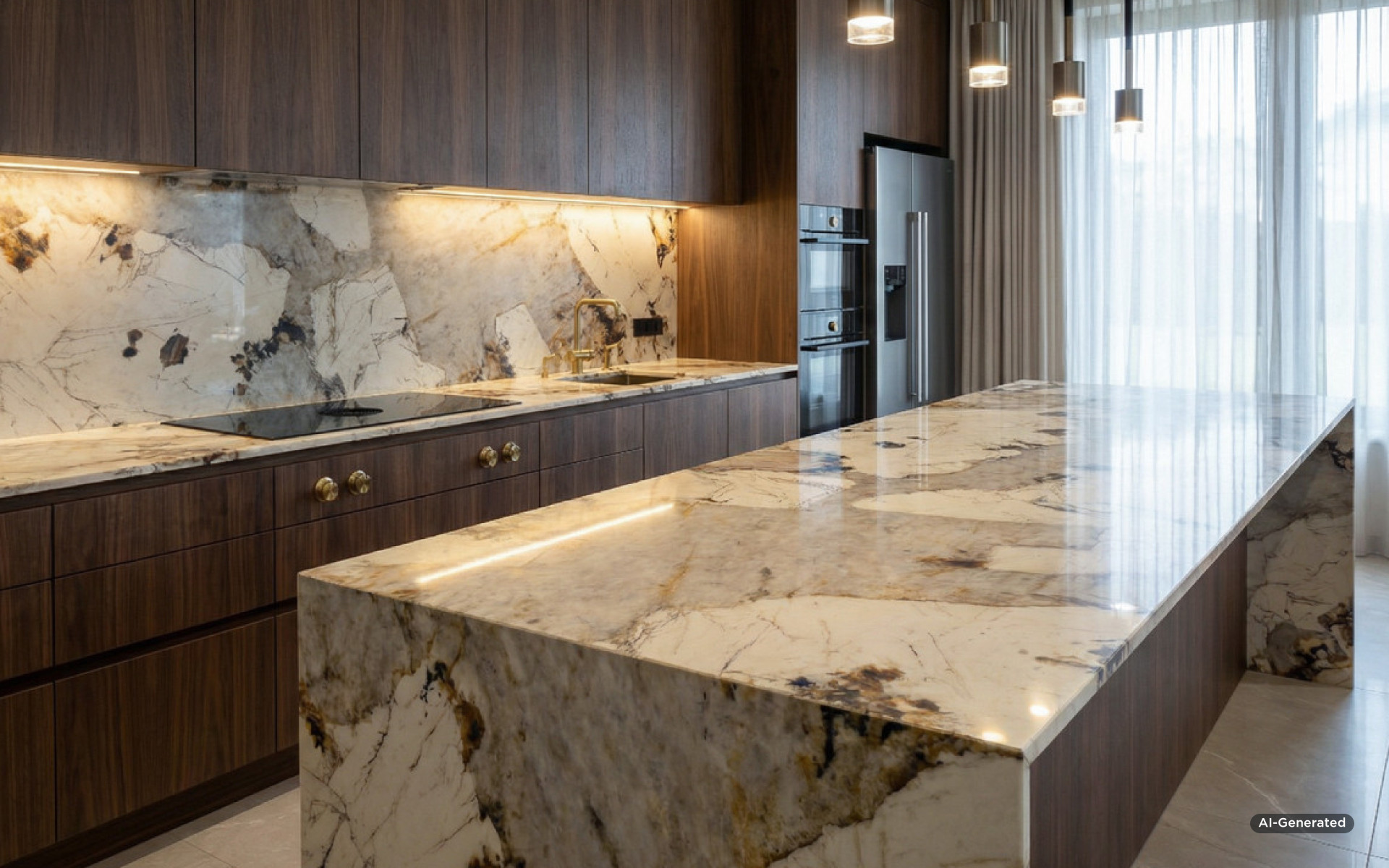
Premium countertops as a natural choice in kitchen design
Selling a higher-end countertop is easiest when it functions not as a separate product, but as part of the overall project. A client who has already accepted a certain level of fronts, fittings, equipment, or appliances may be open to taking the next step – provided they see its value.
Therefore, instead of starting the conversation by asking: "Laminate or quartz?", it is better to show the client a ready concept in several material variants. The frame of reference then changes. The client is not abstractly comparing the price of two materials, but evaluating two versions of their kitchen. They can see how the countertop affects the perception of fronts, island, splashback, or the entire cabinetry.
That is why display and visualization play such a huge role in selling premium materials.
A showroom that helps sell
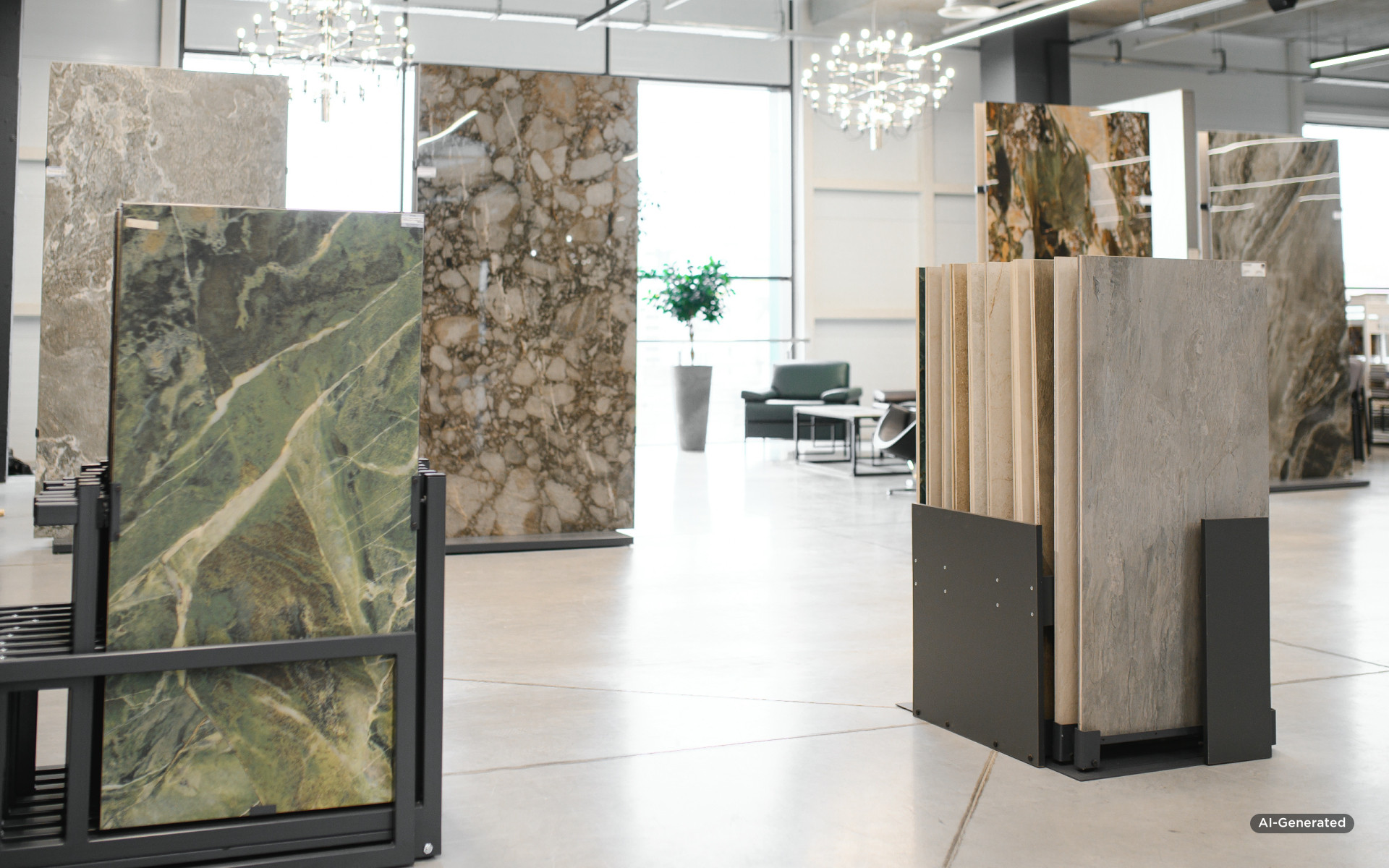
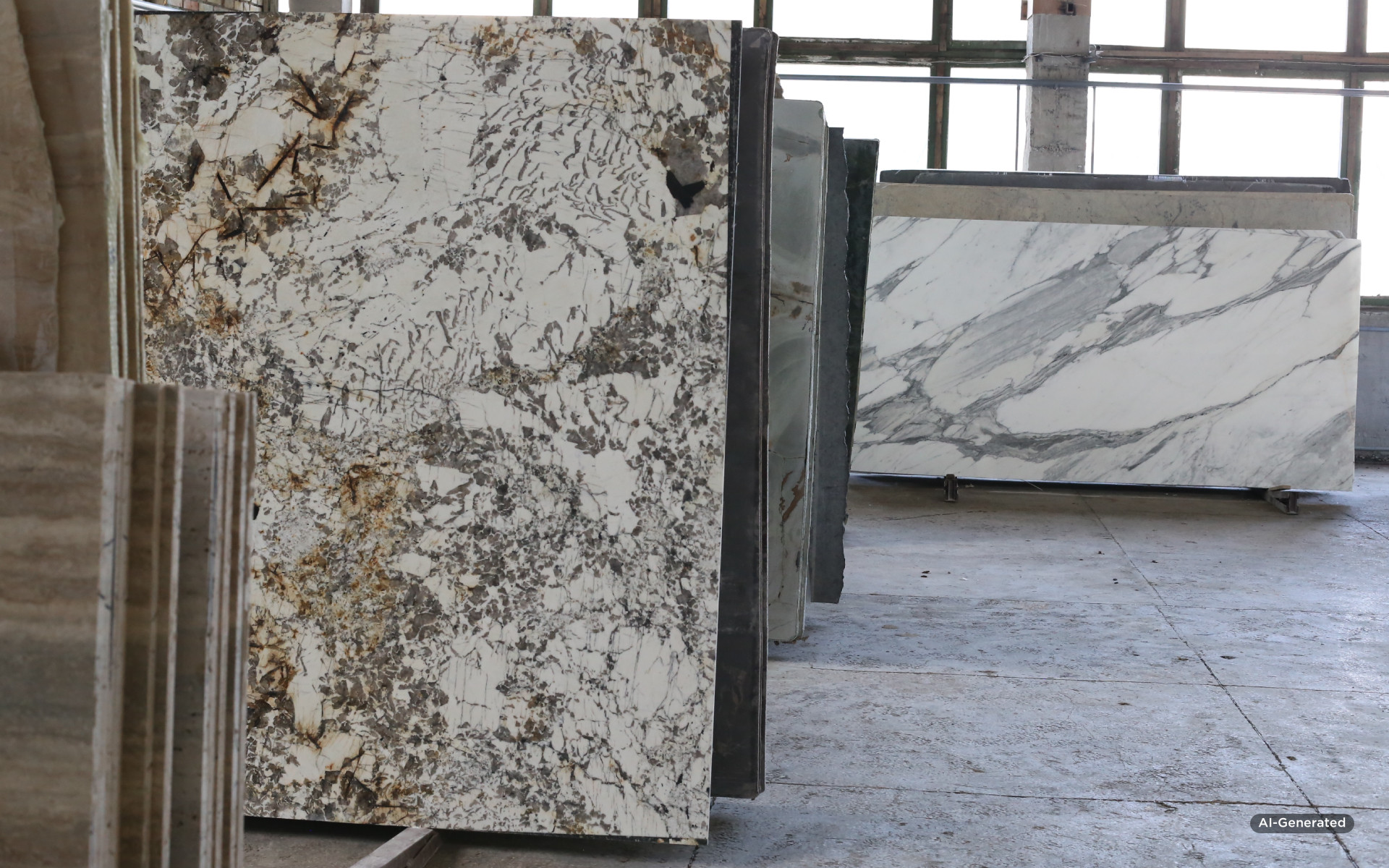
When it comes to premium materials, a photo on a screen rarely replaces contact with a real surface. The client wants to see the color, touch the texture, pair the countertop with a front sample, and check how the decor behaves under different lighting. This does not mean, however, that a studio should display dozens of nearly identical patterns.
Too much choice can hinder a decision rather than facilitate it. It is far more practical to create a representative collection of about 10–15 decors that will guide the client through the key stylistic directions. A starting point can be the items found in the TOP SALES section of Architype, such as Aquitaine Blanca, Calacatta Normandie, Calacatta Oro, or Taj Mahal. The rest of the display should be built not by adding more similar surfaces, but by diversifying choices.
A showroom can feature, for example, light marble-inspired decors, calmer surfaces with subtle veining, warmer stone shades, dark options, and decors with a more distinct character. In this way, a dozen samples are enough to start a conversation with very different clients.
The display should also not remain static for years. It is worth observing which decors clients ask about most often, which end up in projects, and which remain merely samples on a shelf. Thanks to this, the showroom can work as a real sales tool, rather than a catalog of all available possibilities.
Don't just show the sample. Show the client their kitchen
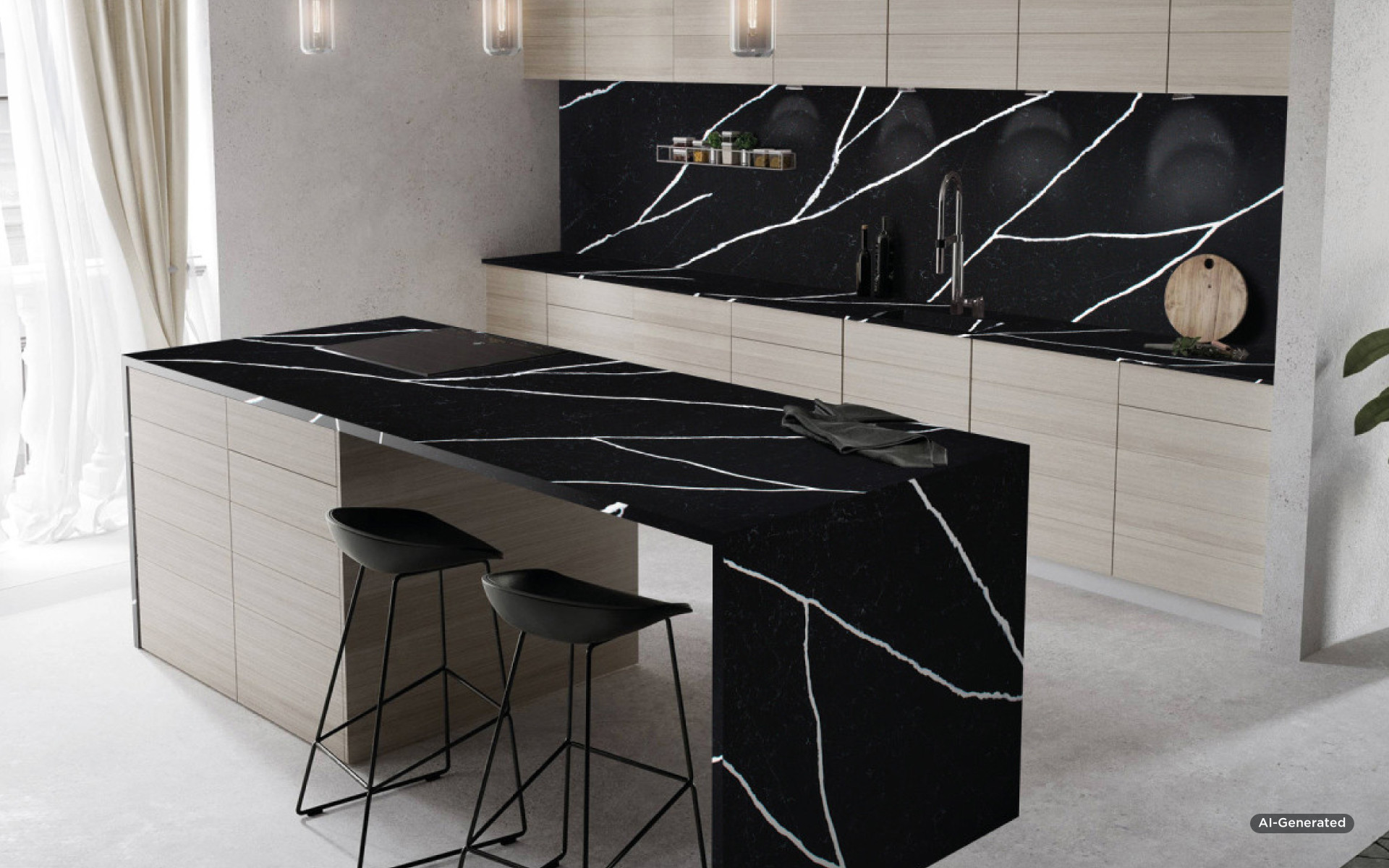
A sample allows evaluating the material up close, but still requires a lot of imagination from the client. A surface fragment of a dozen centimeters looks completely different than a large countertop, island, or wall finished in the same decor. This applies particularly to marble- and stone-inspired patterns, where vein patterning is one of the most important design elements. Therefore, the next stage of sales should be transferring selected decors into visualizations.
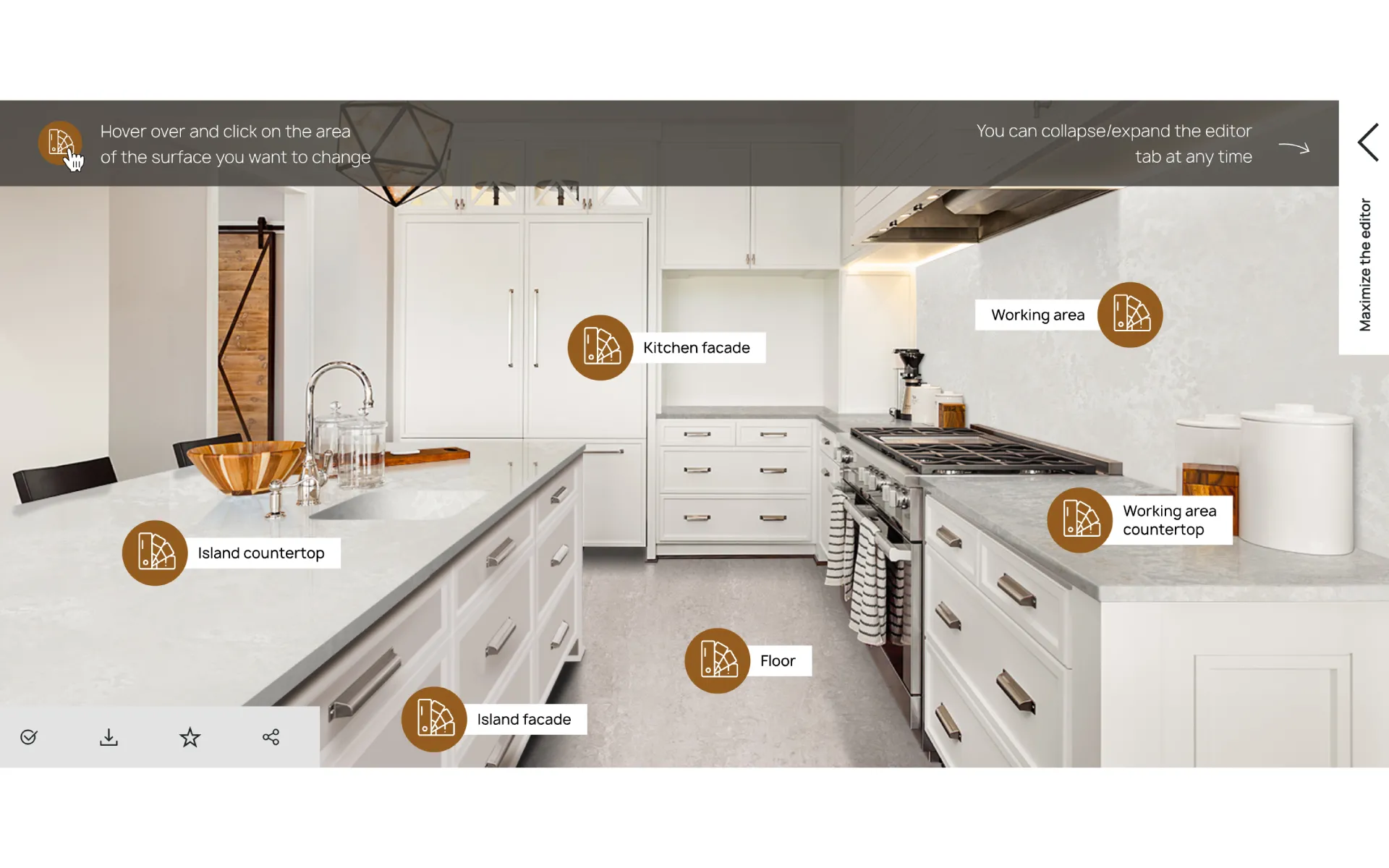
The Architype online visualizer can be used even before making the final on-site measurement. At this stage, it is not about preparing production documentation, but about making an aesthetic decision. For instance, the client chooses three samples that match their color preferences. Next, they can see how each of them interacts with planned fronts, flooring, or interior color palettes.
Instead of trying to imagine the effect, they begin to see it.
This is also a good moment to show an alternative. If the original project assumes laminate, it is worth preparing an additional variant with quartz composite or sintered stone. Not as a solution the client "must" choose, but as an opportunity to compare both versions. The Architype Textures library is also helpful in the design process, allowing materials to be used in visualizations prepared by the studio.
"That's too expensive" – How to talk about premium countertop pricing
Price objections are natural. Quartz or sintered stone can represent a noticeable increase in order value compared to a laminated countertop. The worst response would be pretending that no price difference exists. It is much better to explain where it stems from and what the client receives in return.
"Laminate will be cheaper after all"
Possible response:
"Yes, laminate will be a cheaper solution and will work very well in many kitchens. However, if you care about a more mineral look for the countertop and a premium material effect, we can compare both variants in the design. Then it is easier to judge whether the difference is worth the extra cost."
Such an answer does not depreciate the cheaper solution. Instead, it shifts the conversation from price alone to the effect and client expectations.
"I don't know if it's worth paying so much extra for a countertop"
Here it is worth relating the price to the entire project:
"Let's check first how both solutions look in the entire kitchen. The countertop covers a large area and strongly influences the perception of cabinetry, especially if the design includes an island. After visualization, it is easier to decide whether it is worth allocating a larger part of the budget to it in this specific interior."
The client then does not have to make a decision solely based on a sample and a cost estimate difference.
"I don't see that much difference on the sample"
This is particularly common with decors featuring stronger veining.
"On a small sample, we only see a fragment of the pattern. That's why we can show this decor over a larger area in the visualization. On an island or a long work surface, the effect is completely different."
In this way, we naturally transition from the physical display to the online tool.
"I need to think about it"
You don't always have to close the sale immediately.
You can narrow the choice down to two variants, save them in the project, and allow the client to return to the decision after analyzing the entire cost estimate. It is important that after the conversation they aren't left with a dozen random samples, but with two or three concrete proposals.
Quartz or sintered stone? Sell the solution, not the material name
Quartz composite and sintered stone are different materials, which is why they should not be presented to the client as substitutes with identical properties. Quartz composite is a composite material consisting of quartz aggregate and binders. It features very low water absorption, consistent parameters, and a broad range of decors. It does not require periodic sealing typical of some natural stones. However, one must keep its limitations in mind – including avoiding direct contact between extremely hot cookware and the surface.
Sintered stone, on the other hand, is a ceramic material. Technological differences translate into properties, fabrication options, and applications. From a salesperson's perspective, the most important question is not "which material is better?", but "which material better fits this project and the client's needs?"
Conversations led this way strengthen the studio's position as an advisor rather than merely a seller of another equipment item.
Visualization before measurement, measurement before production
It is worth clearly separating two stages of the process. Visualization serves to choose the solution. It can be created earlier, based on kitchen design, conceptual dimensions, and the selected decor. On-site technical measurement, however, serves countertop production and should account for real site conditions. This order avoids situations where costly measurement is performed for a variant that the client later rejects. First, material, decor, approximate layout, and budget can be agreed upon, and only after concept approval do you proceed to final measurement.
This is particularly crucial for more complex projects: large islands, unusual shapes, slab joins, or sinks and appliances requiring precise cutouts.
Who measures, cuts, and installs the countertop?
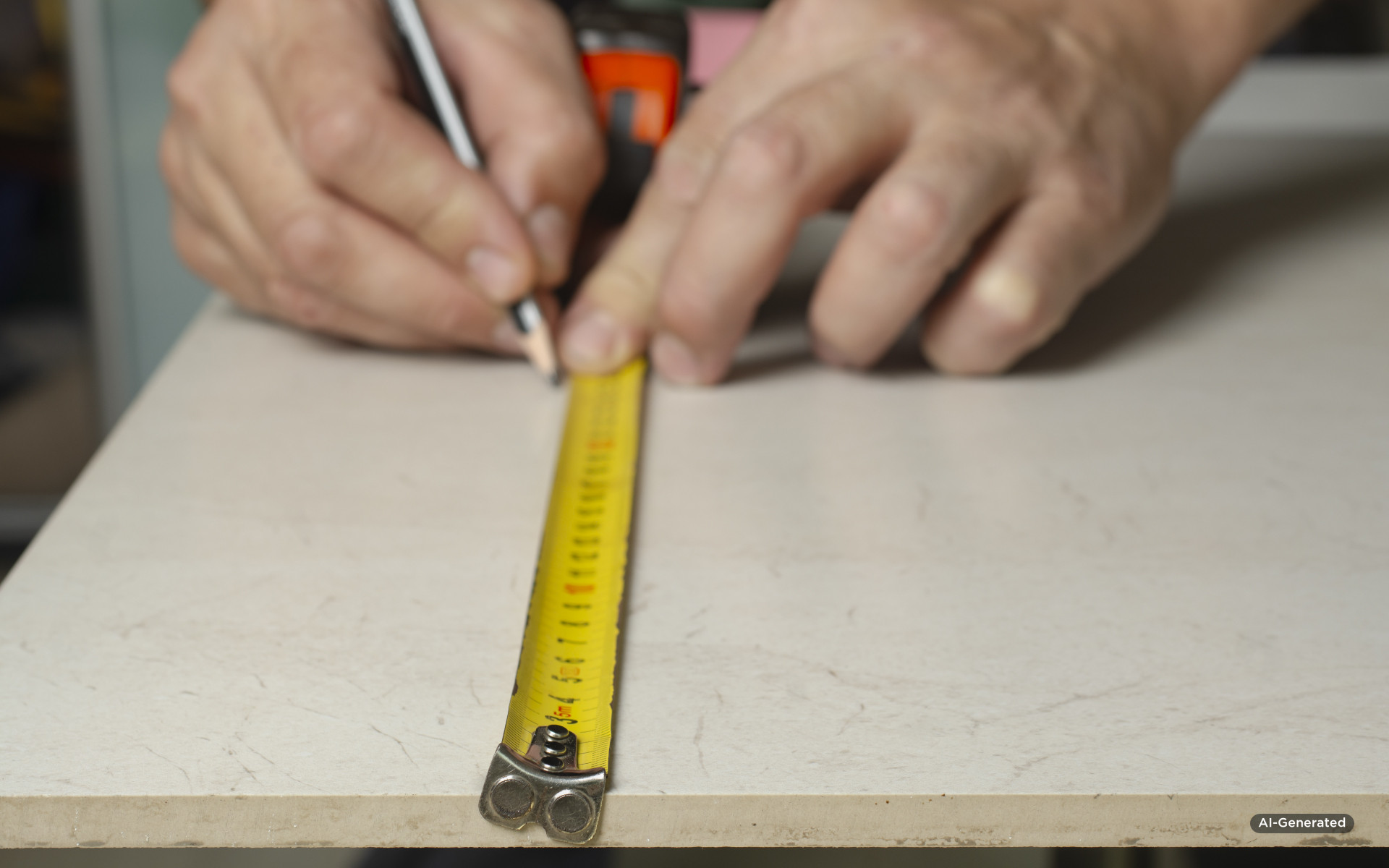
A kitchen studio does not need to execute the entire process in-house to include premium countertops in its offering. One model is cooperation with a specialized stonemasonry workshop or contractor. The studio is then responsible for client contact, kitchen design, material selection, and order coordination, while the execution partner takes over the stage requiring specialized facilities. The scope can include technical measurement, cutting layout preparation, cutting, edge processing, sink/hob/faucet cutouts, transport, and final installation.
The exact division of responsibilities should be established before starting cooperation. Crucially, it must be determined who approves measurements, who is responsible for cutout compliance with appliance specs, who accepts join placements, and who handles any execution warranty claims. A well-structured process means that for the client, the studio remains the place to order a complete kitchen, even if specialized countertop fabrication is performed by a partner.
This carries additional importance for materials containing silica. Cutting, grinding, and polishing require appropriate OSH procedures to limit exposure to respirable crystalline silica dust. Professional execution facilities are therefore vital not only for processing quality, but also for workplace safety.
What makes up the final price of a premium countertop?
For a studio, offering a premium countertop expands the project scope, but the final estimate does not stem solely from the material cost. Overall job pricing also comprises measurement, slab utilization, fabrication, number and types of cutouts, edge profiles, transport, site access, and the installation itself.
Therefore, it is better to think of the final price as a multi-element structure:
- material value,
- design and advisory value,
- measurement cost,
- element fabrication and preparation,
- transport,
- installation,
- execution risk buffer.
Market prices for quartz composite vary greatly. Final pricing depends on chosen decors, thickness, fabrication methods, cutout counts, location, and service scopes. For a studio, the most important factor is not a single "market margin percentage", but accurately calculating the entire order.
Underestimated installation, difficult transport, or unusual fabrication can significantly affect the final project costs. Therefore, every additional operation should be visible in the cost estimate instead of hidden in a single square-meter price.
Good pricing starts before ordering the slab
With premium countertops, mistakes are costly. Therefore, part of the risk should be eliminated before handing material over for fabrication. Before ordering, it is wise to confirm decor availability, appliance dimensions and models, sink/hob mounting methods, edge profiles, join layouts, and transport conditions.
For large elements, even the access path into the room matters. A useful standard is also written client approval of the final layout. Especially for surfaces with distinct veining, it is worth agreeing in advance on decor orientation and element join locations.
These are small process details, but they often determine whether selling a premium product actually yields the studio's target margin.
What should be included in the showroom?
A target display of 10–15 decors does not need to reflect the entire catalog. Its purpose is to initiate a conversation and quickly determine a direction.
Among base offerings, it is worth including Architype bestsellers:
- Aquitaine Blanca,
- Calacatta Normandie,
- Calacatta Oro,
- Taj Mahal.
Remaining spots can be allocated to various aesthetic groups: light marble, warm stone, subtle veining, dark surfaces, calm mineral decors, and one or two more characterful patterns.
Thanks to this, the salesperson does not ask the client: "Which of these 37 decors do you like?", but can start with much simpler questions: "Do you prefer a calmer or a more expressive countertop?"
"Are we going toward cool white or warmer stone?"
"Should the countertop be a backdrop for the fronts or one of the strongest elements in the kitchen?"
Only after establishing the direction do you reach for the broader offering.
How to connect showroom, visualizer, and sales into one process?
The simplest model can be wrapped up in a few stages. First, the client views the kitchen design and sets a general budget. Next, the salesperson presents several materials – including a premium variant – and together they narrow the choice down to two or three decors. The next step involves samples and display. The client can match the surface with fronts, handles, or flooring.
Next, selected variants enter visualization. Only then is a cost comparison prepared, and the client decides whether to stay with the base solution or upgrade to quartz or sintered stone. Upon material acceptance, you proceed to the actual execution process: availability confirmation, technical measurement, fabrication, and installation.
Such a model allows selling premium countertops without aggressive upselling. It is the client who makes the decision, but the studio provides them with the tools needed for an informed comparison.
Cooperation with a stone distributor – what does a studio need?
Introducing premium countertops into an offer is much simpler when a studio doesn't need to build its own material infrastructure. When choosing a supplier, it is worth looking not only at slab pricing, but also decor availability, lead times for custom orders, sample/display access, technical documentation, and material selection support. Tools that the studio can use directly during client conversations are equally important.
As a distributor, Architype offers over 200 decors, including over 100 quartz composite decors available immediately from stock. Partners can also utilize the visualizer, textures, technical materials, and processing/installation guides. Commercial conditions depend on the cooperation model and should be set individually. For a studio, it is therefore important to discuss with the distributor not only prices, but also material availability, logistics, technical support scopes, and display preparation options.
How to start selling premium countertops?
You don't need to rebuild your entire showroom overnight or introduce dozens of new decors. To start, select a representative 10–15 samples, train your team on material differences, and establish a simple conversation script. Next, integrate visualization into your standard design process and find a reliable partner responsible for measurement, fabrication, and installation.
Only then should the next step be analyzing results: which decors sell most frequently, how many clients choose premium solutions, what is the average order value, and at which execution stages additional costs arise. Such a process allows developing the category gradually, rather than treating premium countertops as a single product added to a price list.
Become an Architype Partner
For a kitchen studio or furniture manufacturer, cooperation with a countertop supplier can mean more than access to material. Samples and displays help start conversations with clients. The visualizer and texture library make it easier to showcase selected decors in projects.
Material availability and technical documentation support subsequent execution, while cooperation with a specialized contractor allows offering finished countertops without building your own stonemasonry facility. In this way, selling quartz or sintered stone ceases to be a single line item in a cost estimate. It becomes part of a design process that can increase overall order value.
If you want to expand your studio's offering with premium countertops, check out the Architype "Become a Partner" program and explore available materials, displays, and sales support tools.
FAQ
1. How to sell premium countertops in a kitchen studio?
The most effective way is combining physical samples with a visualization of the specific kitchen. Instead of convincing the client solely with technical parameters, show them the difference between basic and premium variants in their own design.
2. How many decors should be kept in a showroom?
A good starting point is around 10–15 carefully selected decors representing different aesthetic directions. Among them can be Architype bestsellers like Aquitaine Blanca, Calacatta Normandie, Calacatta Oro, and Taj Mahal.
3. Does a studio need to fabricate countertops in-house?
No. A studio can cooperate with a specialized stonemasonry workshop or contractor responsible for technical measurement, cutting, fabrication, transport, and installation. The exact division of responsibilities should be established between partners.
4. Can a visualization be prepared before measurement?
Yes. A visualization used for material selection can be created at the conceptual stage. Final technical measurement should be performed prior to countertop production and account for actual site conditions.
5. How to respond to a client who says quartz or sintered stone is too expensive?
Instead of denying the price difference, show both solutions in the project and explain what the client receives in return. This shifts the conversation from price alone to aesthetics, material properties, and its role in the whole kitchen.
6. What determines the final price of a quartz stone countertop?
Not just the cost of the material itself. The final estimate is also affected by slab utilization, measurement, fabrication, the number of cutouts, transport, and installation conditions. Therefore, the cost should always be analyzed at the level of the entire, personalized order, not strictly based on a starting per m² price.
7. What does cooperation with a distributor provide?
Beyond material access, key benefits include samples and displays, stock availability, technical documentation, design textures, a visualizer, and material selection support. Detailed commercial terms depend on the chosen cooperation model.
Share:


Other publications
All publications
The future of the stone industry and interior design. Which trends will dominate 2027?
References

Architype at Marmomac 2026. Backlit novelties, the return of travertine, and a look at the trends
References

Where to buy large-format sintered stone for the bathroom with high stain and water resistance? A guide to selection and purchase
References