



Where to buy large-format sintered stone for the bathroom with high stain and water resistance? A guide to selection and purchase
References
When designing a bathroom, it quickly becomes clear that the material's appearance is only the beginning. A beautiful marble pattern or stone effect makes an impression, but on a daily basis, how the surface handles water, cosmetics, soap scum, or frequent cleaning is equally important. After all, the bathroom is one of those rooms where finishing materials have to work really hard.
That is why large-format sintered stone is being chosen more and more often. Its very low water absorption, stain resistance, and easy maintenance make it a great fit for walls and floors, as well as near the sink or in the shower area.
How do you choose the right sintered stone for your bathroom, though? What parameters are genuinely worth paying attention to, and where should you buy the material to receive guidance with selection, processing, and implementation alongside an attractive decor? Let's check.
Why does large-format sintered stone work well in the bathroom?
Large-format sintered stone is created from natural mineral raw materials that are pressed and then fired at a very high temperature. As a result, we get a hard, dense surface with extremely low water absorption.
And that is precisely one of its greatest advantages in the bathroom.
In the case of Keralini sintered stone, water absorption is ≤0.1%. In practice, this means that the material absorbs practically no water. It also does not require regular sealing (impregnation), which sets it apart from certain types of natural stone.
This matters everywhere the surface comes into frequent contact with water – by the sink, the bathtub, on the floor, or in the shower area.
The second important feature is stain resistance. Cosmetics, toothpaste, soap, or other everyday products should not easily penetrate the surface. Dirt remains on top, so it can simply be removed during regular cleaning.
If you want to see where else this material can be used, also read: Where to Use Large-Format Sintered Stone.
How to check if sintered stone is truly resistant to water and stains?
You don't need to be a specialist or know all the standards regarding ceramic materials. However, it is worth looking at the product's technical data sheet before purchasing.
Three pieces of information are particularly important:
- Water absorption – indicates the extent to which the material absorbs water. For Keralini sintered slabs, it is ≤0.1%, according to UNI EN ISO 10545-3 / ASTM C373.
- Stain resistance – according to UNI EN ISO 10545-14, Keralini achieves high resistance ratings from class 3 (the standard's minimum) up to the highest class 5, depending on the decor.
- Chemical resistance – the surface will, after all, regularly come into contact with cosmetics and cleaning agents.
However, you don't have to memorise all the standard numbers. The most important thing is for the manufacturer or distributor to provide a technical data sheet and documentation confirming the product's properties. Ask us for the technical data sheet prior to purchase.
Large format means fewer grout lines – and that matters in the bathroom
One of the biggest advantages of sintered stone is the size of the slab itself. Keralini is available, among other sizes, in 1600 × 3200 mm, allowing you to cover a large surface with significantly fewer seams.
The visual effect is striking – instead of many smaller tiles, you get a large, virtually seamless surface. This looks especially good with decors inspired by marble or natural stone.
But aesthetics aren't everything. Fewer grout lines also mean fewer places where soap scum, dust, or cosmetic residue can accumulate. For anyone looking to reduce the time spent cleaning the bathroom, this is a very practical benefit.
Large formats also offer plenty of design possibilities. Sintered stone can be used not only on walls or floors, but also for crafting bathroom countertops, sink claddings, or other interior elements.
Which sintered stone to choose if you don't want to constantly fight water marks?
Here, not only the material itself matters, but also its colour, pattern, and finish type.
On uniform, very dark, and glossy surfaces, water drops or limescale buildup can simply be more visible. If you care about a bathroom that is easy to maintain daily, it is worth considering matte surfaces and decors with subtle veining or patterns.
Options to choose from include:
- Naturale – a matte, more natural finish,
- Levigato – a smoother and glossier surface,
- Structured finishes – featuring a tactile surface texture.
Keep in mind that safety is key: shower floors always demand a surface with an adequate slip-resistance rating. For this reason, we highly recommend reserving the smooth, polished Levigato finish for your walls and vanity tops.
Beiges, greys, and other nature-inspired shades fit into bathrooms exceptionally well. This doesn't mean you have to give up white, black, or expressive marble patterns. It’s simply worth keeping in mind that the surface appearance influences how visible everyday traces of use will be.
A good example is Keralini Calacatta Oro. A light background and distinctive veining allow you to achieve a natural stone effect while retaining all the functional advantages of sintered stone. If you are looking for something bolder, you might also consider Keralini Nero Marquina or Keralini Black Diamond.
The complete Keralini colour palette allows you to compare the available variants.
What about the thickness of the sintered slab?
The Keralini range includes slabs in several thicknesses, such as 6, 12, and 20 mm. However, this does not mean you have to decide entirely on your own which one will be best during purchase.
Thickness is chosen primarily according to the specific application and installation method. Wall cladding may require different parameters compared to a countertop or a heavier-loaded element.
Therefore, instead of following the rule "the thicker, the better," it is worth telling the seller or contractor exactly where the sintered stone will be placed as early as the planning stage. This will allow you to select a solution suitable for your project and avoid unnecessary expenses.
Where to buy large-format sintered stone for the bathroom?
Sintered stone can be found in specialised showrooms and distributors, as well as in some online stores or home improvement stores. With large formats, however, simple product availability shouldn't be the only criteria for your choice.
A 1600 × 3200 mm slab requires proper transport, processing, and installation preparation. Therefore, before purchasing, it is good to check if the seller provides:
- availability of the chosen decor,
- the opportunity to view or order a sample,
- access to technical data sheets and certificates,
- assistance in selecting the correct thickness,
- professional material fabrication/processing options,
- guidance regarding application and installation.
At Architype, Keralini large-format sintered slabs are available, including over 25 decors kept directly in stock. Other variants can be imported to order.
Before making a final decision, it is also worth seeing a sample. The colour and texture of the material can look different on a computer screen, different in a showroom, and different again under the lighting in your own bathroom. This is particularly important for large surface areas – once installed, the slab will become one of the focal points of the entire interior.
Good material is half the success. The other half is installation
Even high-quality sintered stone requires proper preparation and installation. And this is precisely where you shouldn't try to cut corners at all costs.
Large slabs require experience starting right from handling and cutting. A properly prepared, level substrate, the correct adhesive, and properly executed waterproofing in areas exposed to direct water contact are equally crucial.
The shower area and the surroundings of the bathtub demand special attention. Keep in mind that the extremely low water absorption of the sintered stone does not replace the waterproofing layer underneath the cladding. These are two separate elements of bathroom protection.
For large formats, proper coverage and distribution of adhesive under the entire surface of the slab, along with appropriate expansion joints, are essential.
You don't need to know all the technical details of installation, but it is worth choosing an installer who has experience working specifically with large-format sintered stone. This is a much better solution than treating them exactly like small ceramic tiles.
How to care for sintered stone in the bathroom?
One of the advantages of sintered stone is that it doesn't require complex care or regular sealing. Consistency is key on a daily basis. Water and fresh spillages are best removed as they happen, before they dry and leave mineral deposits. For standard cleaning, a soft cloth or sponge and a mild cleaner suitable for the specific surface finish are usually sufficient.
It’s also worth remembering that even a stain-resistant material doesn't mean a surface that never needs cleaning. In the bathroom especially, the issue is often not dirt penetrating the material, but limescale deposits forming on top from hard water.
That’s why when choosing a decor, it’s good to think not only about how it will look right after installation, but also how it will hold up during everyday use.
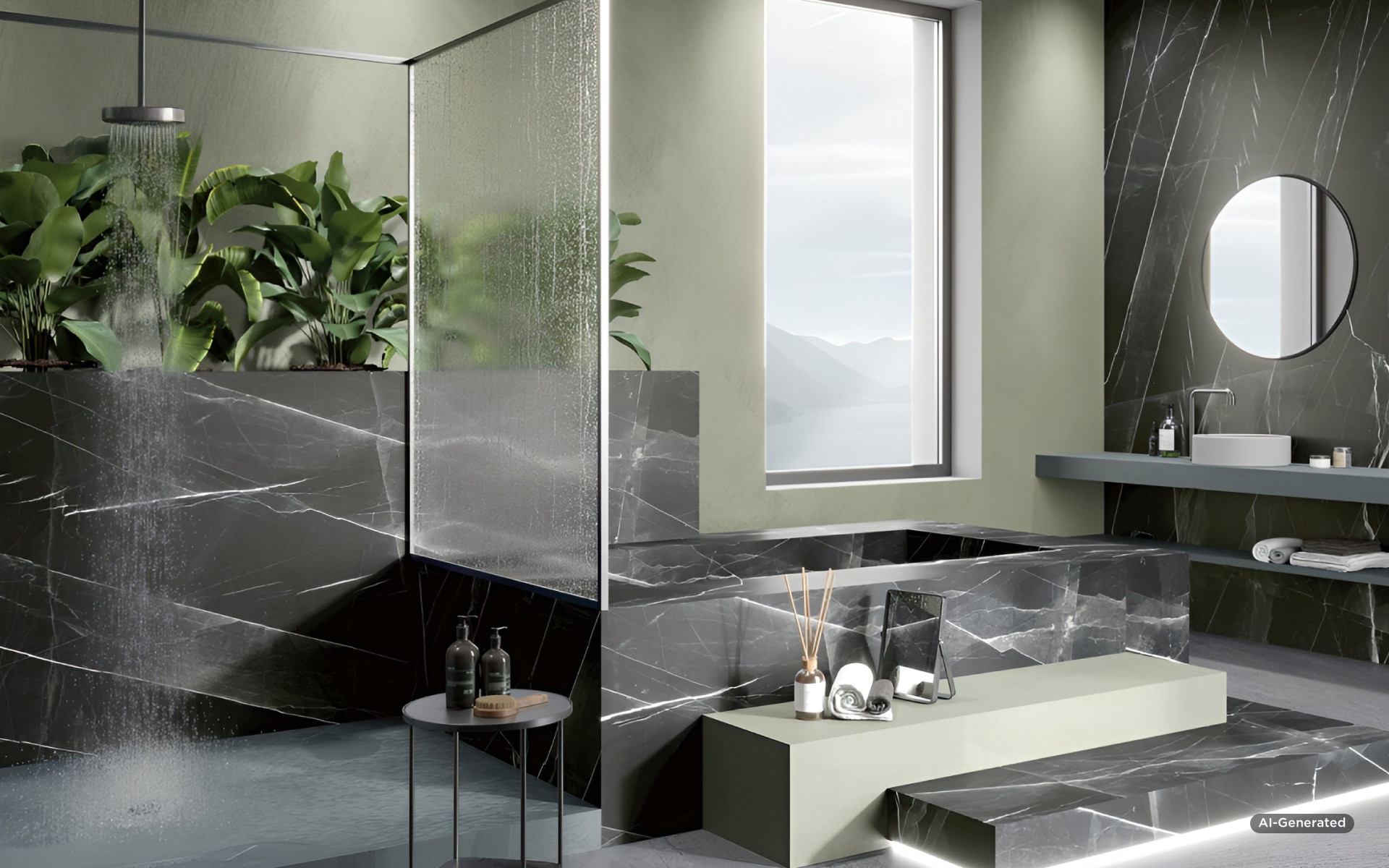
Large-format slab, standard tiles, or natural stone – which to choose for the bathroom?
There is no single best material for every bathroom. Much depends on the desired effect, budget, and area of application.
- Large-format slabs (such as Keralini, classified as porcelain group BIa under EN 14411) are a great solution for those who want a large, impressive surface with minimal grout lines. They feature extremely low water absorption and require no sealing. Standard, smaller tiles offer vast budget and design possibilities, but if you care about a monolithic effect and reducing areas where soap scum accumulates, a truly large format (160 x 320 cm) offers much greater design potential.
- Natural stone possesses something impossible to fully replicate – every slab is unique. However, keep in mind that the properties of individual stone types vary, and many require dedicated sealing and maintenance.
The final decision shouldn't come down to "which material is objectively the best?" It’s much better to ask: which material will be best for my specific bathroom and the way I intend to use it?
How to buy bathroom sintered stone without unpleasant surprises?
Before placing an order, it is worth completing a few steps:
First, choose a decor and view a sample of it. Second, check the material's technical data sheet, paying close attention to water absorption and stain resistance. Next, consult with your installer to determine which slab thickness will be suitable for the intended application and how the material will be processed/cut.
Only then should you calculate the exact amount of material needed. When ordering, make sure to include extra material for cutting waste. It doesn't always have to be a rigid 10% or 15% – with large slabs, a lot depends on the layout of elements, room dimensions, and planned cuts. It is best to calculate material requirements based on a detailed project plan.
If you are wondering which sintered stone will work best in your bathroom, Architype advisors can help you choose the right decor, optimal thickness, and fabrication method.
Feel free to contact us!
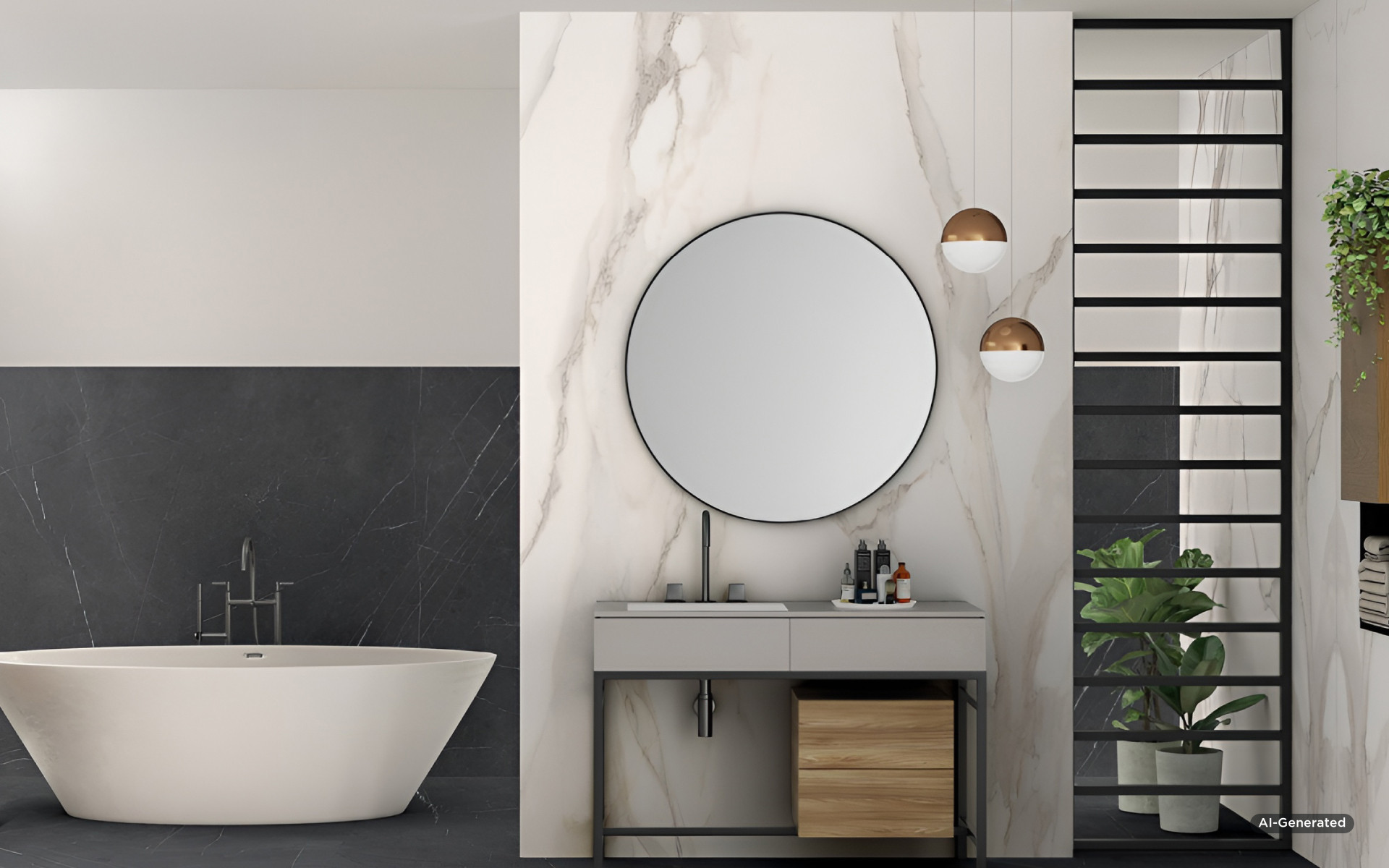
FAQ – Large-format sintered stone in the bathroom
Does large-format sintered stone absorb water?
Sintered stone features extremely low water absorption. For Keralini slabs, it is ≤0.1% according to UNI EN ISO 10545-3 / ASTM C373. As a result, the material is exceptionally well suited for bathroom applications, including areas exposed to frequent water contact.
Does sintered stone need to be sealed (impregnated)?
Sintered stone has a dense, virtually non-porous surface and does not require regular sealing like many natural stones do. You should, however, follow care recommendations appropriate for your specific surface finish.
Is sintered stone suitable for the shower?
Yes, sintered stone can be used as cladding in the shower area. However, proper substrate preparation and waterproofing beneath the cladding are essential.
What thickness of sintered stone should I choose for the bathroom?
This depends on the application site and installation method. A wall cladding may require a different thickness than a countertop or floor. Therefore, it is best chosen based on your specific project and the manufacturer’s recommendations.
Are water spots/limescale visible on sintered stone?
Sintered stone does not absorb water like porous materials do, but hard water limescale can still deposit on its surface. The visibility of water marks depends on the colour, pattern, and finish of the slab. Traces are generally less noticeable on matte, patterned decors.
Is sintered stone easy to clean?
Yes. Thanks to its very low water absorption, dirt stays primarily on the surface of the material, making daily care straightforward. It is always recommended, however, to use cleaning agents in accordance with the manufacturer's guidelines.
Share:


Other publications
All publications
White, cream, or beige? Choosing light large-format sintered stone available instantly
References
Compact HPL in sanitary facilities, locker rooms, and high-traffic areas – a specification guide for architects and investors
References

Architype at Marmomac 2026. Let's meet in Verona!
References